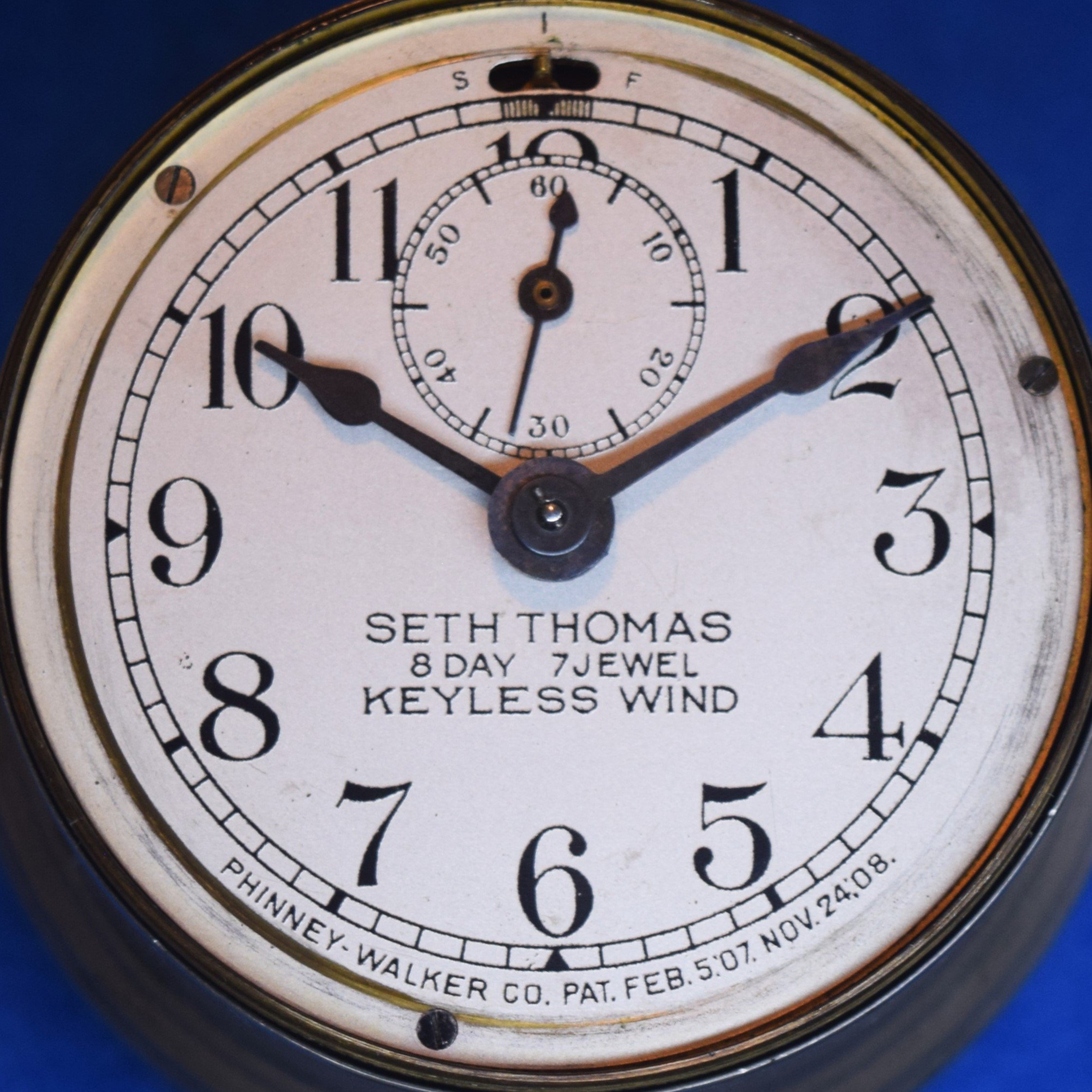
Seth Thomas Mechanical Clocks & Timepieces

Historical Overview of the Seth Thomas Clock Company

Standards of Evidence
Purpose & Scope
The following standards describe how historical claims on this site are evaluated, supported, and, when necessary, revised.
Evidence Hierarchy
This site documents and analyzes Seth Thomas pocket watches using a defined hierarchy of evidence. Claims are weighted according to the quality, proximity, and reliability of the supporting material. This framework is intended to make clear what is known, how it is known, and what remains uncertain.
1) Primary Evidence (Highest Weight)
Used whenever available:
Surviving Seth Thomas pocket watches examined directly, including movement architecture, jewel placement, setting mechanisms, engraving, serial numbers, and manufacturing details observable on the physical object.
Period factory artifacts, defined as original materials produced by Seth Thomas (or its authorized agents) during the active manufacturing period, including:
Factory drawings, patterns, or technical diagrams
Original factory labels, tags, or inspection slips
Movement, dial, or case markings applied at the factory
Factory-issued catalogs, price lists, or sales circulars
Original warranty papers or factory documentation accompanying watches at the time of sale
Contemporary correspondence or documentation issued by Seth Thomas or its distributors
Contemporary trade publications, such as Jewelers’ Circular, jobber catalogs, and period advertisements published during the production era.
City directories, census records, and other contemporaneous public records relevant to retailers, distributors, and private-label entities.
Serial-number clustering and production patterns derived from documented, verifiable examples.
When primary evidence conflicts with later claims, summaries, or reconstructions, the primary evidence prevails.
This category explicitly excludes later compilations, modern databases, retrospective estimates, or secondary interpretations as primary evidence.
However, modern databases and compiled resources still serve important roles, including as discovery tools, cross-reference aids, aggregation platforms, and generators of testable hypotheses.
Claims derived from such sources are treated as provisional and must be corroborated by primary or contemporaneous evidence before being presented as factual conclusions.
2) Secondary Evidence (Contextual Weight)
Used when primary evidence is incomplete or unavailable:
Well-documented horological research published after the manufacturing period that clearly cites primary sources.
Period recollections, memoirs, or historical narratives written close in time to production but not directly tied to factory documentation.
Repeated patterns observed across multiple independent collections when supported by consistent physical characteristics.
Secondary evidence may inform interpretation, but it does not override primary evidence.
3) Inferential Evidence (Conditional / Hypothesis)
Used cautiously and always identified as such:
Logical inferences drawn from partial data, such as extrapolations of production quantities or run boundaries.
Hypotheses based on mechanical similarities, shared components, or observed manufacturing conventions.
Provisional conclusions derived from limited sample sizes.
Inferential evidence is explicitly labeled, subject to revision, and updated when new primary evidence emerges.
4) Unverified or Disputed Claims
Documented for transparency, not endorsement:
Claims lacking sufficient primary or secondary evidence.
Assertions that conflict with documented physical examples.
Statements originating from modern sources that cannot be independently corroborated.
Such claims are identified as unverified, disputed, or unsupported, and are retained only to document the state of discussion within the horological community.
Research Integrity Statement
This site does not publish intentional misinformation. Errors, when identified, are corrected and documented. Interpretive conclusions are revised as new evidence becomes available.
The goal is not to defend prior assumptions, but to follow the evidence wherever it leads.
Reader Guidance
Readers are encouraged to distinguish clearly between:
What is directly documented
What is inferred
What remains unknown
This distinction is essential to preserving the integrity of historical horological research.